
The project has the approval from UNESCO, the Local Commission for Historical Heritage, and the Civic and Social Council for the Landscape of Light
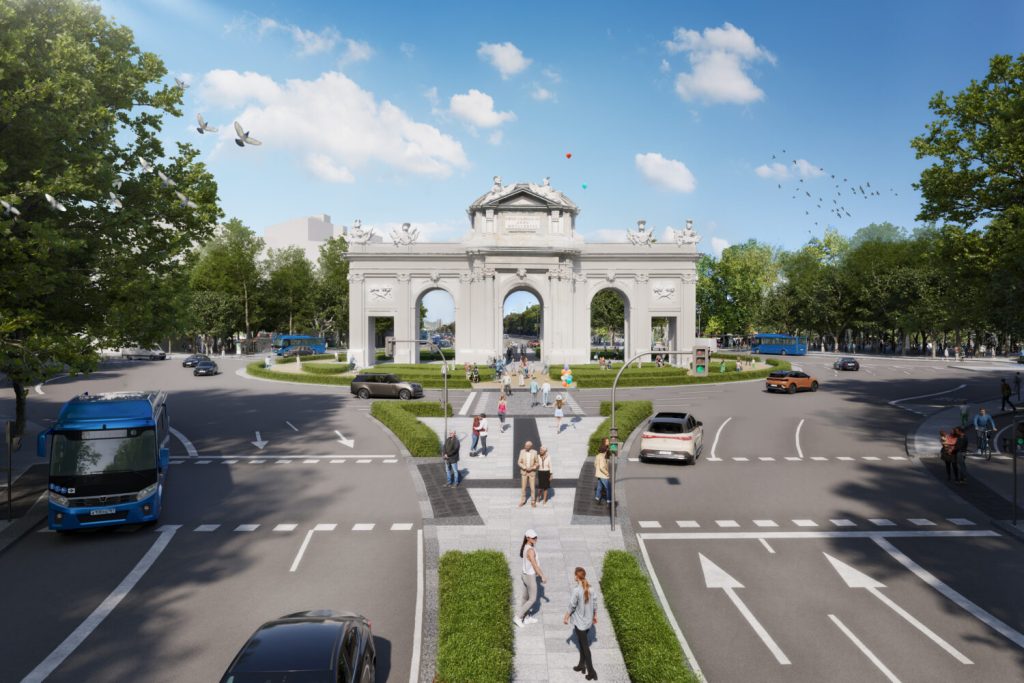
The works, representing an investment of M€6.1 , will begin in early February and are expected to run, as planned, until the first quarter of 2027.
A central promenade will be created, offering a better view of the Puerta de Alcalá, one of the main heritage assets of the Landscape of Light.
The project will restore the original double row of trees along the street, which disappeared in the late 1960s to allow for the carriageway to be widened.
The street’s new layout will enable residents to walk around the monument, which will partly regain its role as a gateway into the city.
The north sidewalk, which carries the heaviest pedestrian traffic, will be substantially widened.
Madrid City Council has given the green light to the remodeling of Calle de Alcalá between Plaza de Cibeles and Plaza de la Independencia. Works will begin in early February and are expected to run until the first quarter of 2027. The announcement was made at a press conference by the Delegate for Works and Facilities, Paloma García Romero, following the weekly meeting of the Governing Board. The project, with an investment of €6.1 million, has received approval from UNESCO, the Local Commission for Historical Heritage, and the Civic and Social Council for the Landscape of Light.
The aim of the intervention is to restore the street’s historic layout and enhance the Puerta de Alcalá through the creation of a central promenade, which will allow residents and visitors to enjoy a better view of one of the key heritage elements of the Landscape of Light. In addition, the street’s new configuration will enable people to walk around the monument, which will partly regain its role as a gateway into the city.
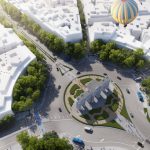
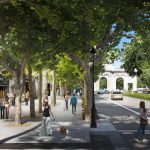
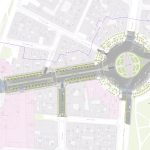
Calle de Alcalá
The project envisions a section with two lanes plus a bus lane in each direction, a 3.8-meter-wide central promenade, and a segregated bike lane on the south side. The space gained by reducing the existing lanes will allow for a substantial widening of the north sidewalk, which bears the greatest pedestrian traffic on the street, and the restoration of the historic double row of trees with the planting of 57 new large trees—one of the essential features of this thoroughfare that had been lost. Additionally, strips of shrubbery will be planted along both sidewalks and the central promenade.
The project includes the complete renovation of the pavement, which will consist of granite slabs and cobblestones, and the resurfacing of the roadway. Furthermore, the streetlights will be replaced with a lamppost model appropriate to the heritage setting, based on the historical design used on Calle de Alcalá, but with high-energy-efficiency LED technology. This will be accompanied by the renovation and expansion of street furniture and the reorganization of spaces designated for outdoor seating areas.
Plaza de la Independencia
The renovation will visually and functionally integrate the Puerta de Alcalá, reducing its character as an isolated monument in a roundabout and bringing it closer to the public. To this end, the garden will be redesigned to restore one of the late 19th-century layouts, allowing for pedestrian access that connects Calle de Alcalá with the triangular area currently used as a contemplative space. A new pedestrian walkway will be created on the west side of the plaza, and the existing walkway on the east side will be improved. In addition, a study of the monument’s lighting will be conducted, modifying the location of the light fixtures and upgrading the projectors.
The project will retain most of the existing paving of the plaza’s sidewalks, which was laid in 2009, while improving accessibility with new pathways to pedestrian crossings and public transport stops to comply with universal accessibility standards. Additionally, one lane will be removed to create a segregated bike lane connecting the bike lane on Alcalá Street with the one on Serrano Street, also providing access to Retiro Park. The work on the plaza will be completed with the renovation and expansion of street furniture, the resurfacing of the entire plaza area, and the redistribution of public transport, increasing the number of stops and creating islands for bus shelters.
Alfonso XI and Pedro Muñoz Seca Streets
On Alfonso XI Street, work will be carried out on the block between Alcalá Street and Valenzuela Street to widen the west sidewalk and change the parking lane from angled to parallel, which will allow for a new row of trees with six new specimens. The paving will follow the same design principles as on Alcalá Street, adjusting its dimensions to the scale of the street. As for Pedro Muñoz Seca Street, work will only be carried out to adapt the intersection to the new configuration of Alcalá Street.