
In this historic area, more than 2,700 tons of waste are generated, all of which ends up in the landfill: 95.4% of it is classified as mixed waste.
The City Council has begun the process of obtaining certification so that at least 90% of the waste generated is recovered or given a second life, with the construction of a waste management facility in the park.
The nearly one thousand litter bins in this large urban green space will be replaced to facilitate source separation.
This initiative aligns with the 2035 European targets, which stipulate that only 10% of waste should end up in landfills, and with the selective collection system established in the facility’s master plan.
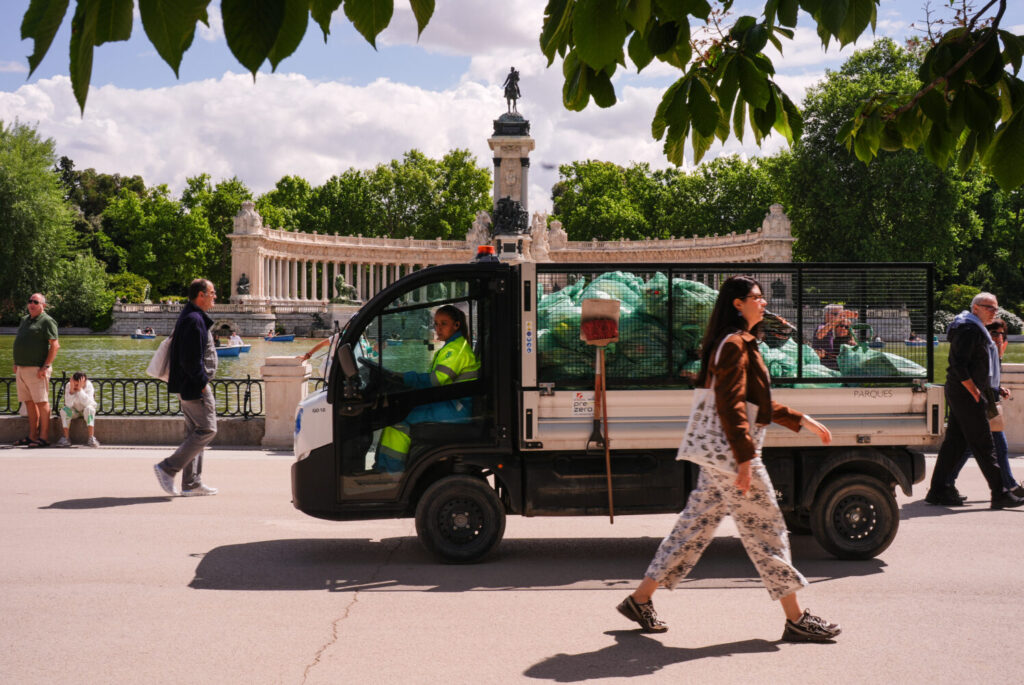
Madrid is increasingly improving its recycling practices, and the city’s main green space should be a prime example. The Madrid City Council has begun the process of converting El Retiro Park, which receives 20 million visitors annually, into the first park certified as ‘Zero Waste’. Currently, the 984 waste bins distributed throughout the 118 hectares of the historic garden do not allow for waste separation. This means that the more than 2,700 tons of waste generated in the park each year end up mixed together in the landfill. Of this amount, 95.4% (more than 2,500 tons) is classified as mixed waste; glass represents 4.1% (108 tons); organic waste, 0.23% (6 tons); and packaging, 0.1% (2.5 tons), the same amount as paper/cardboard. To these figures should be added the pruning waste, which is recycled and amounts to 205 tons.
This is going to change soon. El Retiro, declared a World Heritage Site as a Landscape of Light by UNESCO, will not only be a cultural symbol, but also a benchmark for urban sustainability. The Mayor of Madrid, José Luis Martínez-Almeida, along with the Delegate for Urban Planning, Environment and Mobility, Borja Carabante, and the Councillor for Cleaning and Green Spaces, José Antonio Martínez Páramo, attended the start of construction today on the Retiro recycling center, located in the southern part of the park, near the Rose Garden and the Greenhouse Nursery. Currently, the undeveloped space serves as a storage area for various materials and waste.
The mayor has highlighted the importance of this space, “the historical, heritage, cultural, and environmental heart of the city of Madrid,” emphasizing the improvement of sustainability policies to make El Retiro “the first zero-waste historical park in Europe” by 2027. Almeida detailed the investment of more than 400,000 euros to ensure that “the more than 2,700 tons of waste” generated each year in this park “are reused, recycled, and transformed” in order to “continue conserving, maintaining, and increasing our natural heritage” and so that the more than 20 million people who visit El Retiro each year “can do so in the best possible conditions.”
The new space for the proper separation of waste
The adaptation and improvement of the recycling center is one of the necessary actions to achieve the ‘Zero Waste’ certification starting next year, explained Almeida, who pointed out that, in addition to this project, the City Council will replace the 984 litter bins with a model that allows for source separation.
The works to transform 3,000 square meters into a recycling center represent an investment of 474,000 euros for the City Council, which aims to facilitate the selective collection of waste and provide more storage space in the historic garden. The current asphalt footprint within the plot will be reduced, and five disposal areas will be incorporated to meet the needs of source separation. A new lighting network will also be implemented inside, and the perimeter fence will be maintained to ensure continued restricted access.
With the project already underway, an external certification body, Bureau Veritas, will analyze the waste flows, ensuring that at least 90% is recovered, and will award the official ‘Zero Waste’ certification six months after compliance. The estimated date is the middle of next year.