
The City Council opens the restoration process of the Cibeles Fountain to the public with 2,640 places available for guided tours.
The initiative, organized by the Department of Culture, Tourism, and Sport, will allow visitors to see the conservation work from the inside.
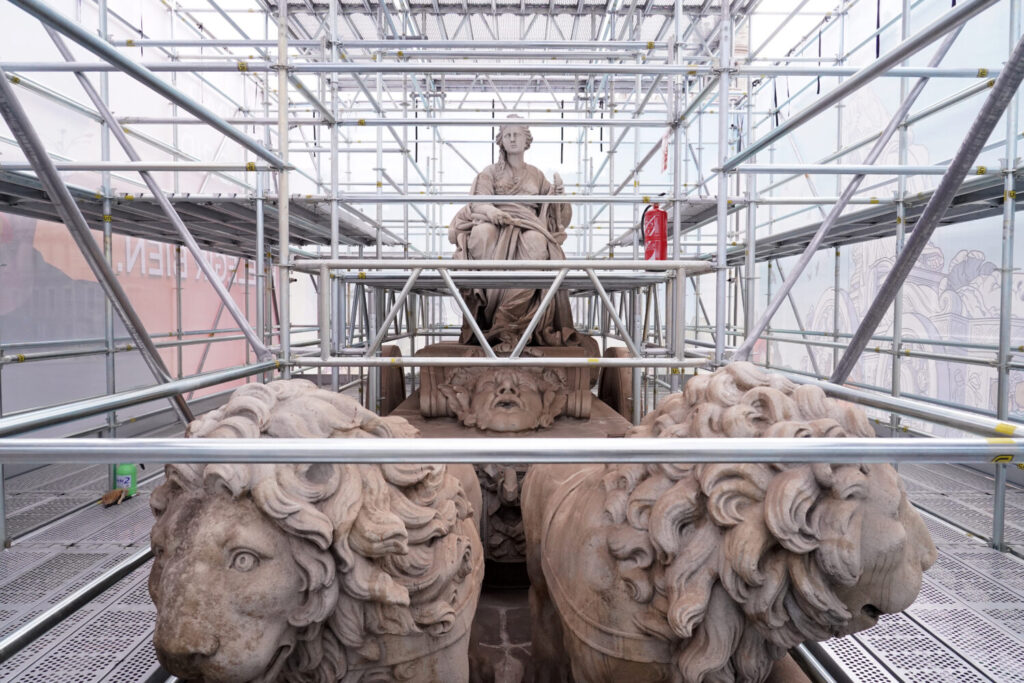
Citizens will be able to access the scaffolding structure surrounding the fountain and contemplate one of Madrid’s great symbols from a unique perspective.
176 guided tours have been scheduled, and places can be reserved free of charge starting July 23 at 10:00 a.m. at reservaspatrimonio.es.
The tours will offer a close-up look at the restoration process and the work of the specialists in charge of the monument’s conservation.
The restoration will have a final cost of approximately €260,000 and will guarantee the conservation of the monumental complex through a comprehensive five-month intervention.
The “Open for Restoration” program will also include visits to the Pavilion of Hexagons, with 72 guided tours and 2,160 places available.
 This summer, the Madrid City Council will bring one of the most important heritage conservation projects of recent years closer to the public. Deputy Mayor Inma Sanz, accompanied by the Delegate for Culture, Tourism, and Sport, Marta Rivera de la Cruz, presented today a new edition of the ‘Open for Restoration’ program, which will allow visitors to see firsthand the work being carried out on the Cibeles Fountain, one of the city’s most iconic monuments. The free tours can be booked starting July 23 at 10:00 a.m. on the website abiertoporestauracion.reservaspatrimonio.es.
Sanz emphasized that “Madrid has an extraordinary heritage that we must preserve for future generations.” With ‘Open for Restoration,’ the aim is for “Madrid residents to also be part of this effort, bringing them closer to work that usually remains hidden and allowing them to discover one of the city’s great symbols from a unique perspective.”
For her part, Marta Rivera de la Cruz pointed out that “the restoration of the Cibeles Fountain not only guarantees the preservation of one of Madrid’s most beloved monuments, but also gives us the opportunity to explain how heritage is protected.” Opening this process to the public “is a way to share knowledge, highlight the work of our restorers, and strengthen the bond between citizens and their cultural heritage.”
A unique opportunity to discover the Cibeles Fountain
The program will offer 176 guided tours with a total of 2,640 places, allowing access, between July and September, to the scaffolding structure erected for the restoration and to view the Cibeles Fountain from a unique perspective. Accompanied by guides specializing in history and art history, participants will learn about the monument’s historical development, the intervention criteria, and the various techniques used to ensure its preservation.
During the tour, visitors will be able to closely observe the sculpture of the goddess Cybele, the chariot, and the lions Hippomenes and Atalanta, as well as discover sculptural and construction details that usually go unnoticed. They will also learn about the main problems detected during the preliminary studies and the solutions adopted to preserve this monumental ensemble.
A comprehensive intervention to guarantee its conservation
The presentation of this initiative coincides with the start of the restoration work, which has a contract value of approximately €260,000 and a five-month execution period.
The studies carried out by the Directorate General of Cultural Heritage and Urban Landscape last year revealed an accumulation of dirt, cracks and fissures, corrosion in metal elements, alterations in the stone, as well as reintegrations and mortars in poor condition in some areas of the monumental ensemble, making a comprehensive intervention necessary.
The work includes cleaning the stone surfaces, removing unsuitable mortars, treating and sealing joints and cracks, applying biocidal and water-repellent treatments, consolidating the stone materials, restoring metal elements affected by corrosion, and implementing measures to improve the monument’s stability, as well as reintegrating minor losses and applying the final color to the ensemble.
To finance the project, the Madrid City Council will once again rely on the support of L’Oréal Groupe Spain, which has collaborated on the restoration of some of the most iconic monuments in other cities, such as Notre-Dame Cathedral in Paris after the 2019 fire and the Neptune Fountain in Madrid in 2024.
The company has contributed a total of €370,000 to the City Council’s monument conservation program, which will cover the entire cost of the work on the Cibeles Fountain, as well as the drafting of its project.
A symbol of Madrid since the 18th century
Designed by Ventura Rodríguez in 1777 as part of the project to beautify the Salón del Prado (1775), the Cibeles Fountain is one of Madrid’s most iconic landmarks. The figure of the goddess was sculpted by Francisco Gutiérrez Arribas, while the lions were the work of Roberto Michel.
Throughout its more than two centuries of history, the fountain has undergone various transformations and conservation efforts. Moved to its current location in 1895, it has been restored on several occasions (1980, 2016) to ensure its preservation. Since 2021, it has been part of the Paseo del Prado and Buen Retiro World Heritage Site, Landscape of Arts and Sciences, known as the Landscape of Light, and continues to be one of the most recognizable and representative monuments of the capital.
As a complement to visits to the Cibeles Fountain, this edition of ‘Open for Restoration’ program will include guided tours of the Hexagon Pavilion, currently undergoing renovation. In total, the program will offer 248 free visits and 4,800 free places, of which 72 visits and 2,160 places will be for the pavilion.
/