
Witness to political and social changes, it is one of the few fairs of its kind in Spain and Europe.
Its heritage value is reflected in the references to it found in numerous literary or cinematographic works.
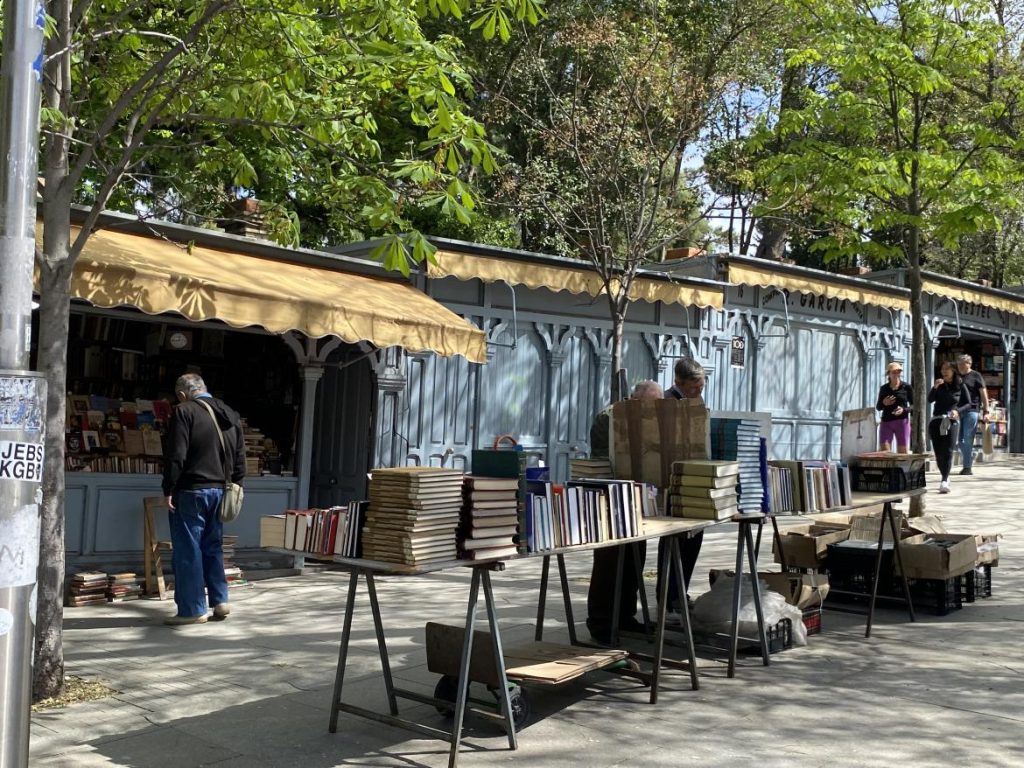
Book fair at Cuesta de Moyano. Current image: (c) Maite Escobar Alférez
The Governing Council of the Community of Madrid has approved the declaration of the Cuesta de Moyano Book Fair as an Asset of Cultural Interest (BIC) in the Intangible Heritage category. This fair is one of the most representative spaces of Madrid’s cultural life and a living testament to the capital’s literary and commercial tradition for over a century.
This measure protects a historic enclave for buying and selling books, traditionally antique and secondhand, which has become a symbol of the city’s identity. Located on Claudio Moyano Street, next to the Royal Botanical Garden, it forms part of the Landscape of Light, included on UNESCO’s World Heritage List, and is one of the few permanent fairs of its kind in Spain and Europe, comparable to the booksellers’ markets along the Seine in Paris.
Throughout its history, it has been much more than a book market, keeping alive cultural and social practices linked to knowledge, reading, and literary exchange. Since its creation in 1925, it has operated daily, with the sole exception of brief interruptions during the Spanish Civil War and the coronavirus pandemic.
A witness to the various political changes and periods in Spanish history, its heritage value is also reflected in numerous literary and cinematic works, such as Camilo José Cela’s *Journey to the Alcarria* and Jaime Chávarri’s film *Bicycles Are for Summer*.
Its origins lie in the old San Mateo fairs, which were held in Madrid until the end of the 19th century. In 1919, vendors began setting up shop in front of the gates of the Royal Botanical Garden, and in May 1925, the City Council approved the creation of a permanent market with 30 stalls selling used books at its current location. The stalls that still house the booksellers today were designed by Luis Bellido, then the city architect.
Anchovy Fair
In the 1920s, it became popularly known as the Anchovy Fair, after the writer Ramón Gómez de la Serna observed that the price of this fish (15 cents) was the same as that of a second-hand one on the Cuesta. During the Spanish Civil War, it continued operating and was only closed for 15 days at the beginning of the conflict.
Over time, the stalls deteriorated and were demolished in 1986. The stalls were then temporarily relocated to the Paseo del Prado while replicas of the originals were being rebuilt.
In July 2004, a fire at a nearby electrical substation forced another temporary relocation to the same avenue. Three years later, the booksellers returned to their usual location, during which time the surrounding area was completely pedestrianized.
The allocation of stalls has transitioned from a system of family inheritance to one of public bidding. Currently, both the Cuesta de Moyano Booksellers Association and the Soy de la Cuesta Association are a fundamental pillar in the preservation and revitalization of this space.