
The Delegate for Culture, Tourism, and Sport, Marta Rivera de la Cruz, presented the festival today, which will take place from March 12 to 14.
The festival will occupy different districts of the city, with Arganzuela as its central hub this year, and also taking place in Retiro, Centro, Chamberí, and Carabanchel.
Matadero Madrid, the Casa del Reloj, the Colonia del Pico del Pañuelo, the Beti Jai pelota court, Plaza de la Villa, and Madrid Río are some of the locations.
Fifteen established and emerging artists and collectives from different countries make up the lineup for this edition, which includes works designed exclusively for LuzMadrid.
The commitment to sustainability remains one of the festival’s hallmarks, and this year it will also host a meeting dedicated to exploring the creative potential of light from multiple perspectives.
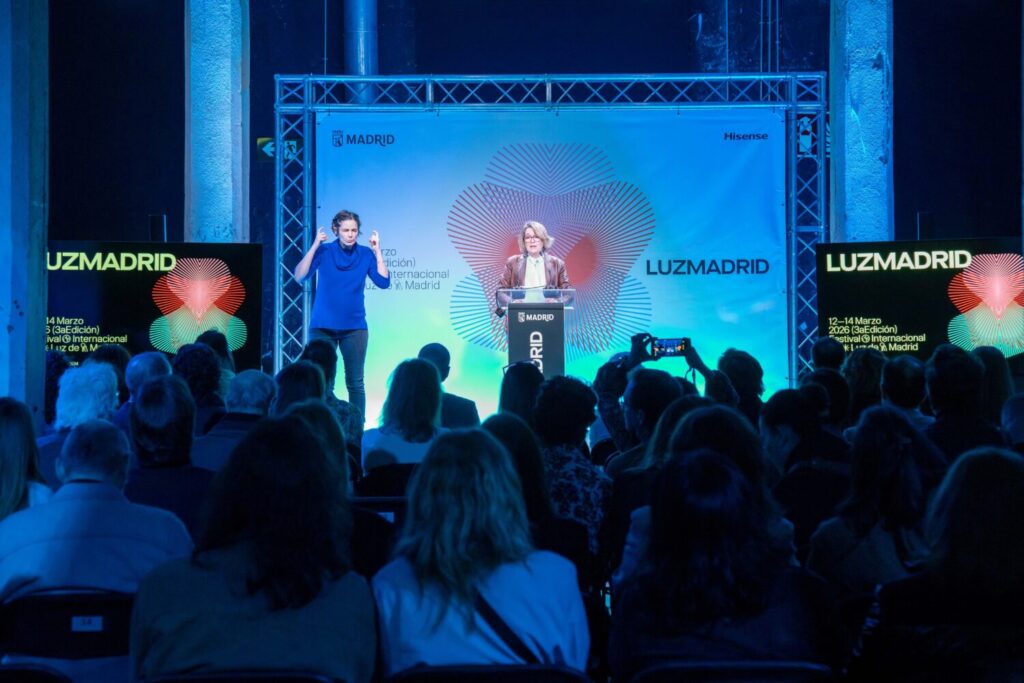 The Delegate for Culture, Tourism, and Sport, Marta Rivera de la Cruz, presented this morning at Nave Una in Matadero Madrid the third edition of the international LuzMadrid festival, which will illuminate the city with 15 art installations in 12 locations from March 12 to 14. During the presentation, the Delegate was accompanied by the festival’s artistic director, Delia Piccirilli, and by Ricardo Morcillo, co-curator of the “LuzMadrid Encounter,” along with Esther Torelló, which will take place on Saturday, March 14.
This year, LuzMadrid focuses on the Arganzuela district, an area characterized by its diverse landscapes and rich architecture, combining an industrial past with recent urban transformations. Emblematic spaces such as Matadero Madrid, the Casa del Reloj (Clock House), Nave de Terneras (Terneras Warehouse), Madrid Río, and the Colonia del Pico del Pañuelo (Handkerchief Peak Colony) offer a particularly valuable route through urban and heritage landscapes. LuzMadrid also maintains its presence in the heart of Madrid, in the Crystal Gallery of the Cibeles Palace, in the legendary Plaza de la Villa, and at the Beti Jai pelota court, a unique venue in the city.
Arganzuela, epicenter of LuzMadrid 2026
The district bordering the Manzanares River is the undisputed star of this edition, which revisits Neo-Mudéjar architecture with the clear intention of offering a fresh perspective on some of the most representative buildings of this quintessentially Madrid style. Thus, Matadero Madrid, the Casa del Reloj (Clock House), and the Nave de Terneras (Calf Shelter) are included in the festival program, along with the Glorieta de San Víctor (San Víctor Roundabout), the Colonia del Pico del Pañuelo (Pañuelo Peak Colony), the multipurpose esplanade, Dam Number 8, the Instituto de Enseñanza Superior Cervantes (IES Cervantes), the area around the Glorieta de Embajadores (Embajadores Roundabout), and the El Águila Cultural Complex.
Beginning the tour at the San Víctor roundabout, an urban landscape that once housed the workers of the old slaughterhouse, is Gonzalo Borondo’s work, created especially for LuzMadrid. Redentora recreates a large zoetrope that sets in motion images of animal victims and their executioners, the slaughterers. It is an installation that reflects on silenced violence, sacred vocation, and ritual as a communal encounter.
In Nave Una at Matadero Madrid, the Barcelona-based research studio Playmodes will present Cluster, an immersive audiovisual installation that reinterprets the architecture of the building and transforms it into a visual and sound language that leads the public on a sensory journey of abstract geometry.
An edition marked by previously unseen works
One of the main characteristics of LuzMadrid is the opportunity to enjoy creations designed specifically for the festival. Artists from Belgium, France, Italy, Mexico, and Canada will showcase their work alongside that of Spanish creators.
Gonzalo Borondo, Sébastien Lefèvre, Playmodes, Camille Gross, cabosanroque + Studio Animal, Cédric Le Borgne, Luzinterruptus, Quiet Ensemble, Collectif Scale, Rafael Lozano-Hemmer, and Studio Lemercier are the artists and collectives participating in this edition, along with the schools of the ‘Emerging Lights’ program: four leading institutions in higher education in art and design: the Madrid School of Design (ESD Madrid), the University of Design, Innovation and Technology (UDIT), the European Institute of Design (IED Madrid), and the Polytechnic University of Madrid (UPM).
Emerging Lights
In collaboration with Central de Diseño, four leading design institutions in Madrid have been selected to present four projects specifically created for the festival as part of the ‘Emerging Lights’ program. This program aims to showcase young creators who incorporate light as a creative medium. Synaxcape, Post.flora, Luminal, and EntreLUZ are the four pieces. The first, created by interior design students at UDIT, proposes an interactive dialogue between body, light, sound, and architecture through a geometric sculpture.
Post.flora is an installation by students from ESD Madrid. Using real plants connected to sensors, artificial intelligence, without human intervention, generates visual forms that extend their presence into a digital realm. Luminal is the piece designed by interior design students from IED Madrid. Based on the concept of the liminal, it proposes a visual and auditory interpretation of the city. Seven translucent layers, each with its own light and sound system, create an ethereal and ever-changing urban landscape. EntreLUZ is an installation by interior design students at the UPM (Technical University of Madrid) that proposes a journey through layers of fabric that make light tangible and transform its perception as visitors move through.
The urban landscape transforms.
Continuing the walk, on the façade of the Clock House, we find the work of French artists Camille Gross and Olivier Magermans present E.T.E.R.N.A., the sap of time, a videomapping installation created especially for LuzMadrid 2026. E.T.E.R.N.A. transforms the Neo-Mudéjar architecture of the Clock House into a living organism, where time ceases to be measured and becomes energy in constant circulation. Through light, image, and sound, the installation invites us to experience a metamorphosis between the organic and the cosmic.
Meanwhile, cabosanroque + Studio Animal, specialists in ephemeral architecture, will occupy the Nave de Terneras with Trànsit, a reflection on how the everyday urban landscape can be transformed into a cultural experience. Forty-nine traffic lights whose lights play to the rhythm of sound form a sensory installation that envelops the viewer and invites them on a journey between movement and stillness, questioning the rhythms that structure urban life.
French artist Cédric Le Borgne will install Nadar La Noche (Swimming the Night) at dam number 8 in Madrid Río. This piece invites viewers to pause and contemplate the urban landscape formed between the Manzanares River and the sky, delicately and poetically illuminating large metal mesh sculptures of koi carp, birds, and other creatures suspended in the air.
In the Madrid Río multipurpose esplanade, the artists’ collective Luzinterruptus will present Paisajes tendidos (Landscapes Hanging Out), a low-tech intervention made with white fabric, wind, light, and the scent of cleanliness. This installation directly relates to the Manzanares River, which for decades served as a vast open-air laundry. Luzinterruptus uses this memory to create a site-specific installation in which more than 100 suspended sheets, illuminated with cool light and moved freely by the air, form a large, walkable clothesline that connects body, memory, and urban landscape.
At the El Águila Cultural Complex, Studio Lemercier will present Blueprint, a creation that puts the unpredictability of nature into perspective. The installation transforms the façade into a large screen activated by light and sound. The audio consists of double bass notes recorded by Yair Elazar Glotman and processed electronically by James Ginzburg. This piece, specially adapted by Studio Lemercier for LuzMadrid 2026, creates a dialogue between its sensory narrative and the industrial history of the complex.
At the Embajadores roundabout, at the IES Cervantes school, French artist Sébastien Lefèvre presents Soleil Nuit, Persée. This work is both a sculptural piece that plays with ambient light and a device that projects bursts of colored light onto its surroundings, leading the observer to discover the vibrations of an Impressionist painting in a kinetic version. Composed of two opposing aluminum circles covered by a mesh of 5,000 mirrors with different tints, during the day it is as changeable as the rays of light piercing through the clouds; in the dark, it acts like a radiant star.
LuzMadrid in other districts
In addition to Arganzuela, the districts of Retiro, Centro, Chamberí, and Carabanchel are also participating in the festival. In the Crystal Gallery of the Cibeles Palace, we find the work of the Italian studio Quiet Ensemble in collaboration with the European Gravitational Observatory (EGO). Firmamento is an installation designed specifically for this location. It is a large-scale geometric structure that translates cosmic data into a choreography of light and sound, integrating a key element of Madrid’s imagery—its sky—into the city’s institutional heart.
In Plaza de la Villa, the French collective Collectif Scale presents Flux, a kinetic and luminous sculpture that, through motorized movements, draws constantly transforming lines of light via rotating helices in direct dialogue with Grégory Sémah’s original sound composition. A visual and acoustic experience that activates the historic space and transforms rhythm into form and light into living matter.
This year, a truly unique location stands out: Beti Jai, one of the most singular buildings in Madrid’s architectural heritage and the last great industrial pelota court preserved in the city. There, the Mexican-Canadian multimedia artist Rafael Lozano-Hemmer presents Thermal Drift, an interactive installation in which visitors’ body heat is transformed into luminous flows that disperse throughout the space. The work reinterprets a technology associated with control, transforming it into a participatory cultural experience—a reflection on presence, image, and power in a historic building restored for the city.
A Critical Reflection on Urban Space
On March 14, the Serrería Belga Cultural Space will host a new edition of the ‘LuzMadrid Encounter,’ a free event structured in two sessions, one in the morning and one in the afternoon. Entitled ‘The Illuminated City: Art, Landscape, and Perception,’ the morning program is especially geared towards lovers of art, architecture, design, and lighting.